Skip to content
  • Our Work
    • Fields
      • Cardiology
      • ENT
      • Gastro
      • Orthopedics
      • Ophthalmology
      • Pulmonology
      • Surgical
      • Urology
      • Other
    • Modalities
      • Endoscopy
      • Medical segmentation
      • Microscopy
      • Ultrasound
  • Success Stories
  • Insights
    • Computer Vision News
    • News
    • Upcoming Events
    • Blog
  • The company
    • About RSIP Vision
    • Careers
  • FAQ
Menu
  • Our Work
    • Fields
      • Cardiology
      • ENT
      • Gastro
      • Orthopedics
      • Ophthalmology
      • Pulmonology
      • Surgical
      • Urology
      • Other
    • Modalities
      • Endoscopy
      • Medical segmentation
      • Microscopy
      • Ultrasound
  • Success Stories
  • Insights
    • Computer Vision News
    • News
    • Upcoming Events
    • Blog
  • The company
    • About RSIP Vision
    • Careers
  • FAQ
Contact

Blog

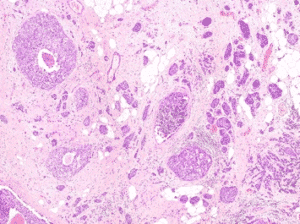
Detecting Mitosis Using Deep Neural Networks
State and progression of breast cancer are assessed through prognostic factors, one of which is the mitotic figure. In a histological sample taken from patients, the fraction of breast tissue cells undergoing replication is used to grade the cancer. RSIP Vision’s algorithms allow fast detection, recognition and classification of the mitotic state of a cell using automatic computational autonomous tools: deep neural networks help distinguish complex patterns in images and finally differentiate between mitotic and non-mitotic cells.

Read More
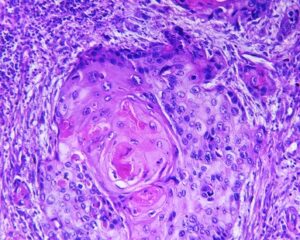
Squamous cell carcinoma

Automatic segmentation of tumor cells
Molecular analysis of in histology enables quantification of abnormality in a given tissue, assess patient condition, and devise treatment. Tissue samples taken in biopsy allow researchers to screen for therapeutic agents but might not accurately capture the bulk tumor, due to its irregular non-cylindrical shape. This calls for an automated segmentation of tumor cells: RSIP Vision does that in several phases, concluded by machine learning methods which study the cell texture and classify the image accordingly. The end result is a fast and life-saving biopsy scanning and analysis system.

Read More
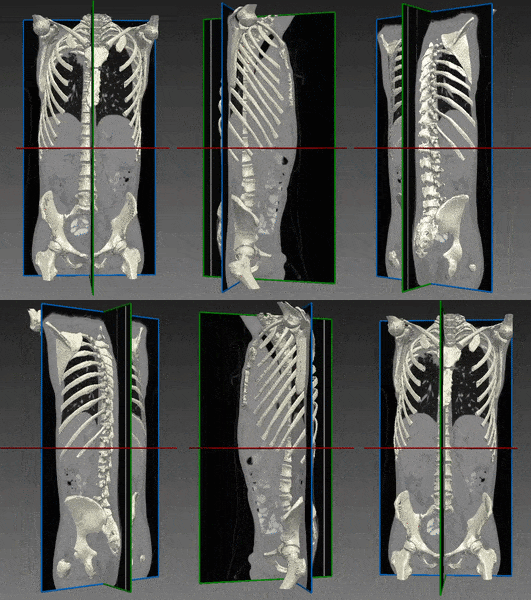
Bones and Skeleton

Bones and Skeleton segmentation

RSIP Vision suggests an automatic segmentation procedure based on iterative binarization of bone tissues density, as observed in Computed Tomography (CT), the most common 3D process used for bone imaging. This method is particularly fast, regardless of whether contrast was used in the CT scans. In fact, images taken with contrast generally display blood with an intensity which is similar to bone; our technique is able to overcome this challenge and to deliver a fast and satisfying bones segmentation and skeleton segmentation solution to our client.

Read More
Lung tumor - zoom

Lungs tumors and nodules segmentation with Deep Learning
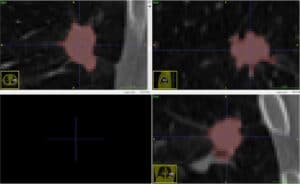
It is visually more difficult to identify lung tumors than nodules, since the latter are supposed to have an elliptical shape, while the chromatic aspect of the former is quite hard to distinguish from healthy tissues on a CT image. We use Deep Learning neural networks to overcome this difficulty in a way that is quick to perform, reliable and memory efficient. Our software of computer vision in pulmonology detects and classifies tumors and nodules in the fastest time, to provide our clients a quick and reliable 3D segmentation of lung tumors with Deep Learning.

Read More
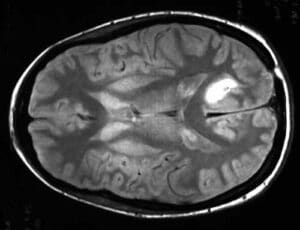
Brain Tumor Segmentation

Brain tumor segmentation

In addition to primary tumors, the human brain can also suffer from secondary tumors or brain metastases. The most common cancers that spread from remote areas to the brain are lung, breast, melanoma, kidney, nasal cavity and colon cancers. By the way of segmenting the tumor in the image, brain tumor image processing overcomes anatomical structure challenges. AI-based techniques enable to estimate the volume and spread of the tumor and provide objective and variation-free expected tumor boundaries.

Read More
Prostate Segmentation

Prostate segmentation in MR images
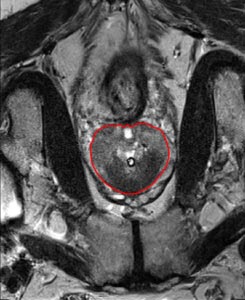
Prostate cancer is the second most common cancer among American men, with more than 200,000 new cases diagnosed every year and about 1 man in 7 diagnosed during his lifetime. Volume is a key indicator of the health of the prostate, revealing key information about the stage of the cancer, the probable prognosis and viable treatment. The rich experience of RSIP Vision enables us to recommend an approach based on a semi-automatic prostate segmentation to give a precise estimate of the prostate volume.

Read More
Lung CT scans

Lung Nodule Classification

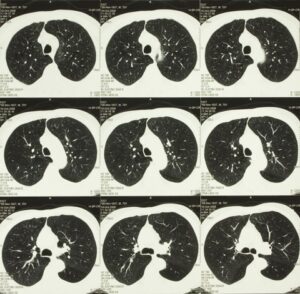
Lung cancer early detection is a vital task which is made difficult by the small size of pulmonary nodules, the detection of which on thousands of CT scans every day is excessively time-consuming. Computer-aided lung nodule classification can dramatically boost the speed of diagnosis. Recommended solution starts from bidimensional images obtained from CT scan and displaying suspicious nodules areas: these are inserted into an autoencoder, from which two hundred dimensional features are extracted. These learned features are then confronted with a trained classifier to produce the final lung nodules classification.

Read More
Chest CT registration

Chest CT Registration

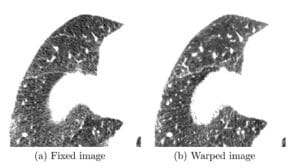
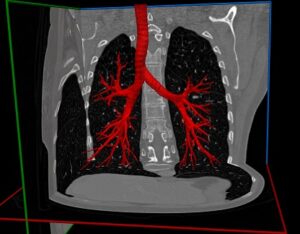
Lung cancer is the leading cancer killer of men and women in the U.S. and it causes more deaths than colorectal, breast and prostate cancers
Read More
Airways Segmentation

Airways segmentation with Deep Learning
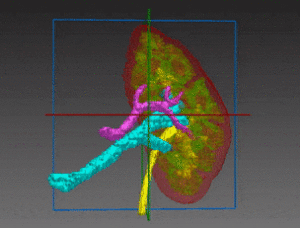
Image processing is a fundamental technique in the quest to identify lung cancer, one of the main causes of death among both men and women, and many other lung pathologies. For the worst diseases, survival rate depends on the stage in which the disease is diagnosed and correct segmentation of airway vessels offers the most effective solution to determine the lesion’s size and location, significantly improving diagnosis and treatment. Our  solution is built upon Deep Learning and neural networks.

Read More
Kidney segmentation

Kidney Segmentation

The most dramatically common kidney diseases are: kidney cancer, hitting 50,000 new patients every year only in the U.S.; and kidney failures, which leave the organ unable to remove wastes. Laparoscopic partial nephrectomy operations remove or reduce kidney tumors and some renal malfunctions. We at RSIP Vision help by providing a semi-automatic and very accurate kidney segmentation technique, built on deep learning and neural networks to create a kidney model which would be specific for each patient.

Read More
< Page1 … Page20 Page21 Page22 Page23 Page24 Page25 >

Animal Monitoring With Pattern Recognition

Automatic Identification of Pigs in a Pen Using Pattern Recognition   The growing demand for animal products is characterized, at the farmer’s end, by an

Read More

On-Combine, Multi-Sensor Environmental Data Collection

Article Summary: On-Combine, Multi-Sensor Data Collection for Post-harvest Assessment of Environmental Stress in Wheat    Continuing our series examining interesting articles in the field of computer

Read More

Applications in Precision Agriculture

Image Processing Applications in Precision Agriculture In this page, you will learn about image processing applications for precise agriculture. If you want to boost your

Read More

Indoor Scene Structure Analysis

Summary: Indoor Scene Structure Analysis for Single Image Depth Estimation   This is the first of our series of summaries of interesting texts on computer
Read More
Catheter measurement in angiography

Automatic Catheter Orientation Measurement
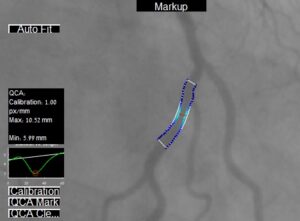
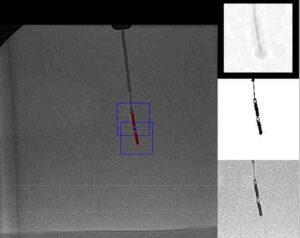
Catheters are inserted with measurement equipment at their tips, in order to scan their immediate surroundings. While orientation of the catheter’s tip is unknown throughout insertion, RSIP Vision has employed advanced algorithmic techniques to provide an exact measurement of catheter orientation during angiography, enabling the physician to ascertain the orientation of the catheter’s tip from x-ray images.

Read More
Quantitative Coronary Analysis

Quantitative Coronary Analysis

The main contribution of Quantitative Coronary Analysis (QCA) consists in measuring the diameter of arteries. Angiograms provide coronary images of region suspected of lesions using which our advanced algorithms for vessel detection and segmentation measure the segmented artery’s diameter. Abnormal values (as compared to a constructed reference diameter) are suspected as stenosis. Our system extracts and displays relevant values to the view of medical professionals and their patients.

Read More

Right Atrium Measurement with Ultrasound

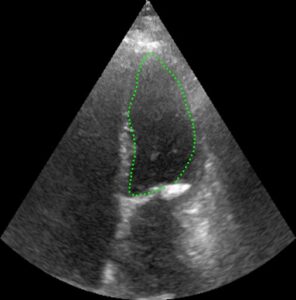
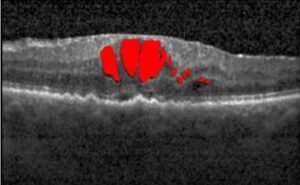
Right Atrium Measurement in Ultrasound Videos   Atrial fibrillation is an irregular rhythmic beating of the heart associated with coronary heart disease, high blood pressure
Read More
Cyst detection

Finding Cysts, Part Five: Final Detection
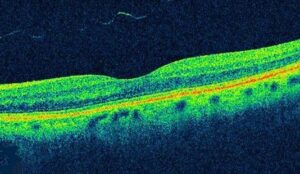
The goal is to automatically detect the appearance of Cystoid Macular Edema (CME) in Optical Coherence Tomography (OCT) images. The deep learning technique used, Convolutional Neural Networks, takes as an input patches of pixels from within the retina. These patches were generated from previous segmentation of retinal images. A further segmentation of the retina is performed using an image processing algorithm called SLIC. Every superpixel thus generated, after being labeled as in the OCT scan, is fed into the neural network to detect the cyst.

Read More
OCT scan

Explaining OCT Scans

What are OCT Scans? Optical coherence tomography (OCT) is a non-invasive imaging method, which produces high-resolution volumetric histological images of tissue. To penetrate deep into biological

Read More

Finding Cysts Part Four: Seed Detection

A series of five articles on our Cysts Detection project using deep learning and Convolutional Neural Networks: 1) our cyst detection method; 2) the cyst denoising process; 3) the retinal layer segmentation; 4) the automatical seed-detection; 5) the final detection of the cysts. Our method is exceptionally successful at finding the cysts themselves and most of their area. Remarkable results are achieved even when using relatively small datasets in the training process.

Read More
< Page1 … Page20 Page21 Page22 Page23 >

Get in touch

Please fill the following form and our experts will be happy to reply to you soon

Recent News

Announcement – XPlan.ai Confirms Premier Precision in Peer-Reviewed Clinical Study of its 2D-to-3D Knee Reconstruction Solution

IBD Scoring – Clario, GI Reviewers and RSIP Vision Team Up

RSIP Neph Announces a Revolutionary Intra-op Solution for Partial Nephrectomy Surgeries

Announcement – XPlan.ai by RSIP Vision Presents Successful Preliminary Results from Clinical Study of it’s XPlan 2D-to-3D Knee Bones Reconstruction

All news
Upcoming Events
Stay informed for our next events
Find quick answers here
FAQ
Follow us
Linkedin Twitter Facebook Youtube

contact@rsipvision.com

Terms of Use

Privacy Policy

© All rights reserved to RSIP Vision 2023

Created by Shmulik

  • Our Work
    • title-1
      • Ophthalmology
      • Uncategorized
      • Ophthalmology
      • Pulmonology
      • Cardiology
      • Orthopedics
    • Title-2
      • Orthopedics
  • Success Stories
  • Insights
  • The company
  • FAQ