



 29 / 56

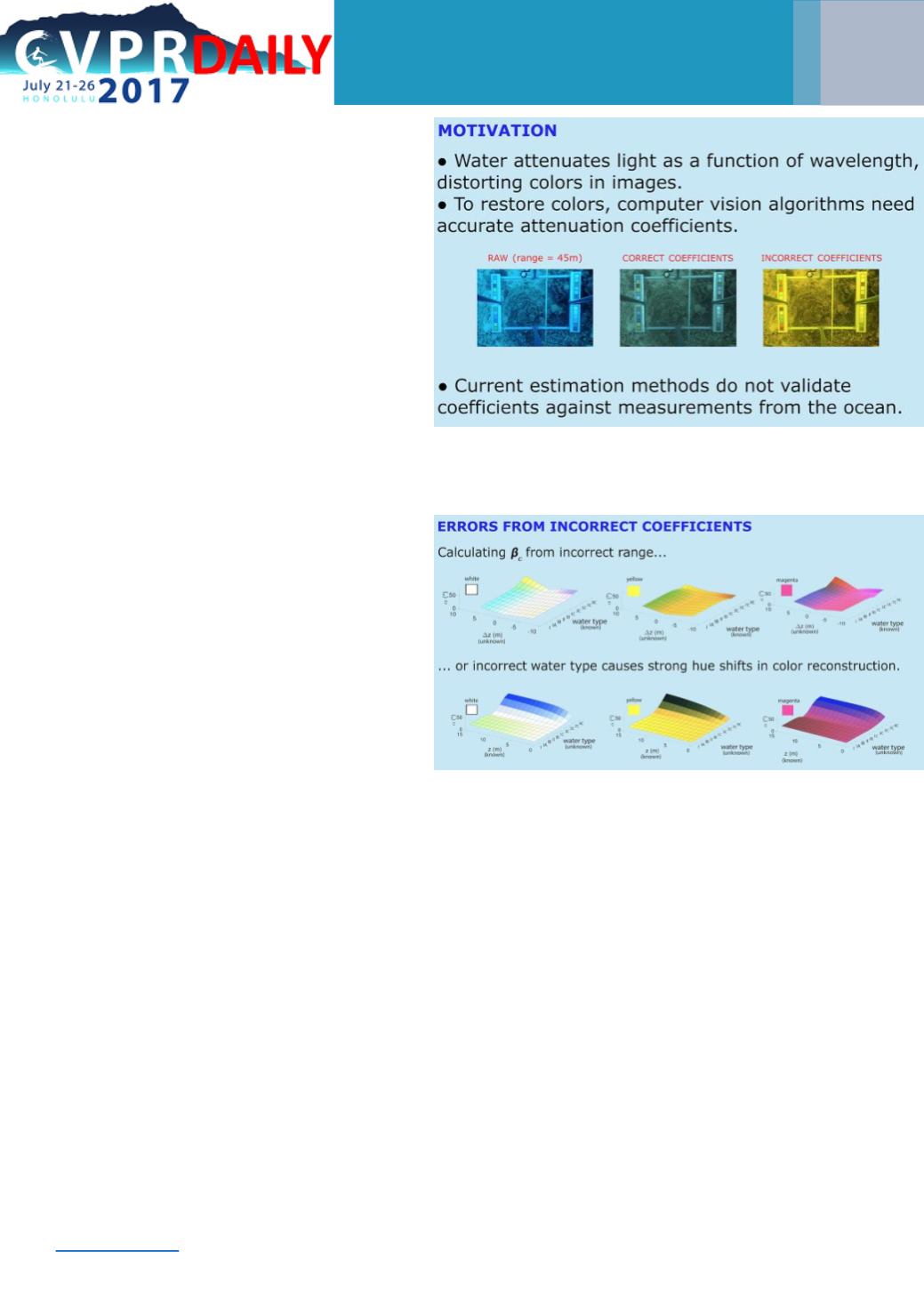
What was important and key in their
work, and their biggest contribution,
is that they have brought over eight
decades of knowledge from optical
oceanology into Computer Vision.
Because in Computer Vision,
researchers
estimated some
coefficients that they use to correct
colors. “
But they never checked if
those coefficients actually make sense
given ocean conditions
”, Derya says.
And in Oceanography it is known that
light attenuation changes by place and
by time, which oceanographers have
mapped for the last eight decades
with various instruments, from very
simple to very technical. So what they
have done in this work together with
Tali Treibitzis to bridge Computer
Vision and Oceanography.
Derya also told us about what she
thinks is the biggest misconception
about underwater imaging: “
In almost
99% of underwater Computer Vision
papers I read, people state that light
attenuated unevenly underwater; red
attenuates faster than blue or green
”.
And this is exactly what happens in
waters that are dominated by
plankton (small plants that drift in the
water), she explains. But if you go to
coastal
water, where there is
contamination from rivers, soil,
sediment and other non-organic
substances, actually blue attenuates
faster than red.
Derya presented her work at a
CVPR2017 poster session.
SaturdayDerya Akkaynak
29
So it’s possible to un-do that effect,
but she is unsure if it will be
commonplace enough to just put
on a mask and that this mask will
compensate for everything. She
thinks that such a mask will
probably complicate diving a bit,
and might be more interesting for
commercial applications.
“
Our next step is to now derive a
new system of equations for
underwater image formation
”,
Derya says, “
to compensate for the
two weaknesses that we found
”.
They want to be able to tell people
what kind of errors they should
expect when they use the old
equations, and they can then judge
how good their results are when all
the errors are taken out.
For their work, Derya and her co-
authors used image formation
equations that are known to be
used for camera and image
simulation.
“Our work has implications for those
working with other scattering media,
such as milk and wine”
BEST OF CVPR